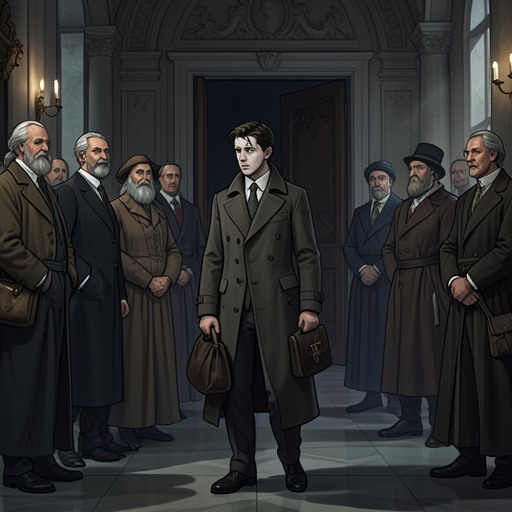
"Rough hands and heavy boots"
Great Expectations“Coarse hands and thick boots” is the phrase Pip comes to associate with the shame Estella awakens in him at Satis House. What had been ordinary features of a blacksmith’s apprentice become, under her contemptuous gaze, marks of a supposedly inferior class; the phrase therefore records the moment Pip begins to measure himself against a gentility he does not possess.
The Insult at Satis House
During their card game, Estella mocks Pip for calling the knaves “Jacks,” then points to his hands and boots as further evidence of his coarseness. The rebuke is not merely about his mistake at cards: she dismisses him as a stupid, clumsy labouring-boy. Miss Havisham watches and observes that Estella says hard things while Pip says nothing in return, making his silence part of the scene’s imbalance.
The insult changes Pip’s attention. He had not previously thought of being ashamed of his hands; now Estella’s contempt becomes infectious, and he adopts it as his own. In the courtyard, he examines his hands and common boots and judges them as vulgar appendages. He even wishes Joe had been more genteelly brought up, imagining that a different education for the blacksmith might have made Pip genteel too. The class judgment has moved inward: Pip no longer sees only Estella’s disdain but begins to use it to interpret himself and the people he loves.
Humiliation and Its Immediate Aftermath
When Estella brings him bread, meat, and beer, she places the mug on the stones and hands over the food without looking at him, treating him, in Pip’s perception, like a dog in disgrace. He feels humiliated, hurt, angry, and sorry, though he cannot settle on a name for the pain. Seeing that tears have started in his eyes, Estella looks pleased to have caused them. Pip manages to hold the tears back while she is watching, then hides behind a gate in the brewery lane and cries, kicking the wall and twisting his hair.
Back with Joe, Pip connects the humiliation directly to the details Estella had attacked. Sitting in the ashes at Joe’s feet, he says that he wishes Joe had not taught him to call knaves Jacks and wishes his own boots were not so thick and his hands so coarse. He tells Joe that Estella called him common and that he wishes he were not. He also links the lies he has told to this wish to escape commonness, though he cannot explain exactly how the connection arose. Joe answers that lying cannot make anyone less common and insists that Pip is uncommon in some ways, including being unusually small and a scholar.
From a Day’s Insult to a Changed Life
Joe’s reassurance does not immediately undo the shame. That night Pip imagines how Estella would judge Joe as a mere blacksmith, measuring him by the same thick boots and coarse hands. He contrasts the kitchen life of Joe and his sister with the world he imagines Miss Havisham and Estella inhabit, far above ordinary domestic work. Although only hours have passed since his visit, he falls asleep remembering it as if it belonged to weeks or months earlier: the encounter has already begun to turn into a defining story about himself.
The adult narrator identifies the day as memorable because it made great changes in him, comparing a life’s consequences to a long chain whose first link is formed on a single day. He does not present the change as the product of Estella alone: he later acknowledges that his state of mind may have been his own fault, Miss Havisham’s, or his sister’s, but says that the change had been made. The episode thus marks an origin, not a complete explanation, of Pip’s developing class shame.
Shame, Home, and Retrospective Judgment
When Pip’s apprenticeship to Joe becomes real, he can no longer see the forge as the road to manhood and independence he had once imagined. He feels marked by coal dust and burdened by the prospect of the work; the road ahead seems flat, low, and dim. He is glad, in retrospect, that he never complained to Joe during his apprenticeship, but that restraint coexists with a deepening sense of alienation.
Pip later calls it miserable to feel ashamed of home. Joe had once made the home seem worth believing in, from the parlour and kitchen to the forge; after Pip’s visit to Satis House, he regards its rooms and work as coarse and common, and does not want Estella or Miss Havisham to see them. The phrase’s force lies in this reversal: the hands and boots are not simply physical details but the signs through which Pip learns to repudiate his origins. Much later, when Miss Havisham’s supposed plans for him prove to have been a dream and Estella was never intended for him, Pip recognizes that he had mistaken his place in the household. His recollection of Estella’s influence remains unsparing, but it also exposes the cost of the class ideal he had built around her: in pursuing a different identity, he had deserted Joe and become ashamed of the home that had once sustained him.